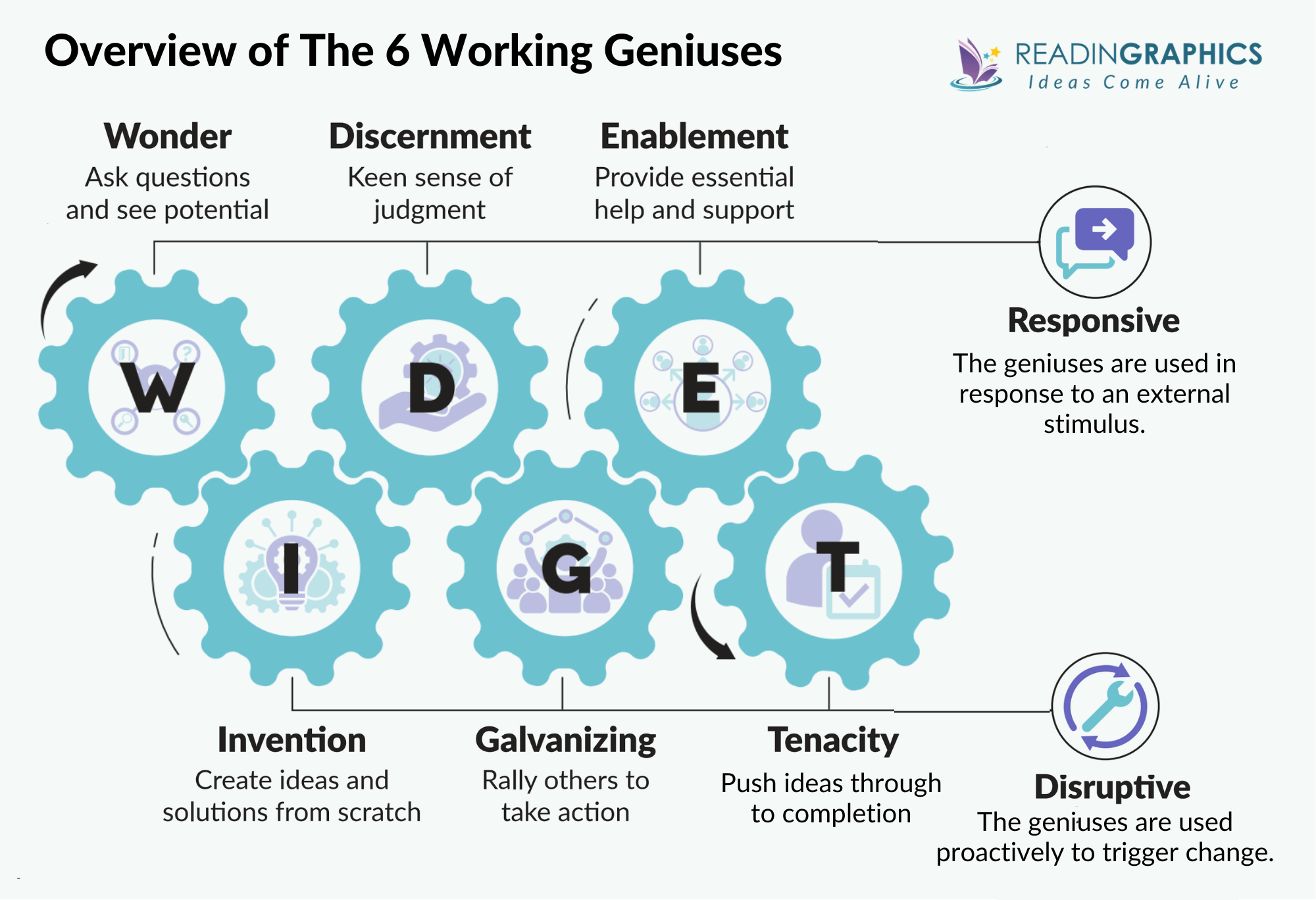
6 working genius is a concept developed by organizational psychologist Dr. Susan David to describe the six essential traits that she believes are necessary for workplace success. These traits are:
- Emotional Agility:
- Cooperation:
- Curiosity:
- Cognitive Flexibility:
- Purpose:
- Courage:
Dr. David believes that these traits are essential for workplace success because they allow individuals to navigate the complex and ever-changing world of work. Emotional agility, for example, helps individuals to manage their emotions and stay focused under pressure. Cooperation helps individuals to build strong relationships with colleagues and clients. Curiosity helps individuals to learn new things and adapt to new challenges. Cognitive flexibility helps individuals to think creatively and solve problems. Purpose helps individuals to stay motivated and engaged in their work. Courage helps individuals to take risks and stand up for what they believe in.
The 6 working genius traits are important for workplace success because they help individuals to:
- Be more productive
- Be more creative
- Be more resilient
- Be more adaptable
- Be more effective leaders
If you want to be successful in the workplace, it is important to develop these six traits. You can do this by:
- Practicing emotional agility
- Building relationships with colleagues and clients
- Seeking out new learning opportunities
- Challenging your assumptions
- Finding your purpose
- Taking risks
1. Emotional agility
Emotional agility is one of the six working genius traits identified by organizational psychologist Dr. Susan David. It is the ability to manage emotions and stay focused under pressure. This trait is essential for workplace success because it allows individuals to navigate the complex and ever-changing world of work.
When individuals are emotionally agile, they are able to:
- Stay calm and focused under pressure
- Manage their emotions in a healthy way
- Bounce back from setbacks
- Adapt to change
- Build strong relationships
Emotional agility is a key component of workplace success because it helps individuals to be more productive, creative, resilient, and effective leaders. For example, a study by the University of California, Berkeley found that emotionally agile employees are more likely to be promoted and to earn higher salaries. Another study by the Harvard Business Review found that emotionally agile leaders are more likely to create high-performing teams.
If you want to be successful in the workplace, it is important to develop your emotional agility. You can do this by:
- Practicing mindfulness
- Learning to identify and manage your emotions
- Building resilience
- Seeking out support from others
Developing your emotional agility will help you to navigate the challenges of the workplace and to achieve success.
2. Cooperation
Cooperation is one of the six working genius traits identified by organizational psychologist Dr. Susan David. It is the ability to build strong relationships with colleagues and clients. This trait is essential for workplace success because it allows individuals to create a positive and productive work environment.
When individuals are cooperative, they are able to:
- Work effectively with others
- Build trust and rapport
- Resolve conflict peacefully
- Share ideas and resources
- Support and encourage one another
Cooperation is a key component of workplace success because it helps individuals to be more productive, creative, and resilient. For example, a study by the University of Michigan found that cooperative employees are more likely to be promoted and to earn higher salaries. Another study by the Harvard Business Review found that cooperative teams are more likely to be high-performing.
If you want to be successful in the workplace, it is important to develop your cooperation skills. You can do this by:
- Being friendly and approachable
- Listening to others
- Being willing to help others
- Building relationships with people from different backgrounds and perspectives
- Seeking out opportunities to collaborate
Developing your cooperation skills will help you to build strong relationships with colleagues and clients, and to achieve success in the workplace.
3. Curiosity
Curiosity is one of the six working genius traits identified by organizational psychologist Dr. Susan David. It is the ability to learn new things and adapt to new challenges. This trait is essential for workplace success because it allows individuals to stay ahead of the curve and to be successful in a constantly changing world.
When individuals are curious, they are able to:
- Learn new things quickly and easily
- Adapt to new challenges
- Be open to new ideas
- Be creative and innovative
- Solve problems
Curiosity is a key component of workplace success because it helps individuals to be more productive, creative, and resilient. For example, a study by the University of California, Berkeley found that curious employees are more likely to be promoted and to earn higher salaries. Another study by the Harvard Business Review found that curious teams are more likely to be high-performing.
If you want to be successful in the workplace, it is important to develop your curiosity. You can do this by:
- Asking questions
- Reading books and articles
- Taking courses
- Attending workshops and conferences
- Talking to people from different backgrounds and perspectives
Developing your curiosity will help you to learn new things, adapt to new challenges, and achieve success in the workplace.
4. Cognitive flexibility
Cognitive flexibility is one of the six working genius traits identified by organizational psychologist Dr. Susan David. It is the ability to think creatively and solve problems. This trait is essential for workplace success because it allows individuals to find new and innovative solutions to challenges.
- Adaptability: Cognitive flexibility allows individuals to adapt to change and to think outside the box. This is important in the workplace because it allows individuals to find new and innovative solutions to challenges. For example, a study by the University of California, Berkeley found that cognitively flexible employees are more likely to be promoted and to earn higher salaries.
- Creativity: Cognitive flexibility allows individuals to think creatively and to come up with new ideas. This is important in the workplace because it allows individuals to develop new products and services, and to find new ways to improve existing processes. For example, a study by the Harvard Business Review found that cognitively flexible teams are more likely to be high-performing.
- Problem-solving: Cognitive flexibility allows individuals to solve problems quickly and efficiently. This is important in the workplace because it allows individuals to overcome challenges and to achieve their goals. For example, a study by the University of Michigan found that cognitively flexible employees are more likely to be successful in their careers.
- Decision-making: Cognitive flexibility allows individuals to make decisions quickly and confidently. This is important in the workplace because it allows individuals to make decisions that are in the best interests of the organization. For example, a study by the University of Texas at Austin found that cognitively flexible leaders are more likely to be effective.
Overall, cognitive flexibility is an essential trait for workplace success. It allows individuals to adapt to change, to think creatively, to solve problems, and to make decisions. By developing this trait, individuals can increase their chances of success in the workplace.
5. Purpose
Purpose is one of the six working genius traits identified by organizational psychologist Dr. Susan David. It is the ability to stay motivated and engaged in work. This trait is essential for workplace success because it allows individuals to find meaning in their work and to stay motivated even when faced with challenges.
When individuals have purpose, they are able to:
- Find meaning in their work
- Stay motivated even when faced with challenges
- Be more productive
- Be more creative
- Be more resilient
Purpose is a key component of the 6 working genius traits because it provides individuals with the motivation and drive to succeed. Without purpose, individuals are more likely to become discouraged and to give up when faced with challenges. However, when individuals have purpose, they are able to stay motivated and to achieve their goals.
There are many ways to develop a sense of purpose in the workplace. One way is to find a job that aligns with your values and interests. Another way is to set goals for yourself and to work towards achieving them. Finally, it is important to find a mentor or role model who can provide you with support and guidance.
Developing a sense of purpose in the workplace is essential for success. When individuals have purpose, they are more likely to be motivated, productive, and creative. They are also more likely to be resilient and to achieve their goals.
6. Courage
Courage is one of the six working genius traits identified by organizational psychologist Dr. Susan David. It is the ability to take risks and stand up for what you believe in. This trait is essential for workplace success because it allows individuals to overcome challenges, to achieve their goals, and to make a difference in the world.
- Calculated Risk-Taking: Courageous individuals are willing to take calculated risks in order to achieve their goals. They are not afraid to step outside of their comfort zones and to try new things. For example, a salesperson who is willing to cold call potential customers is demonstrating courage.
- Moral Courage: Courageous individuals are also willing to stand up for what they believe in, even when it is unpopular or difficult. They are not afraid to speak out against injustice or to defend the rights of others. For example, an employee who speaks out against unethical behavior is demonstrating moral courage.
- Resilience: Courageous individuals are resilient in the face of adversity. They do not give up easily, and they are able to bounce back from setbacks. For example, an entrepreneur who faces multiple failures before finally achieving success is demonstrating resilience.
- Self-Belief: Courageous individuals have a strong belief in themselves and their abilities. They are confident in their ability to achieve their goals, even when others doubt them. For example, a student who starts their own business despite having no experience is demonstrating self-belief.
Courage is an essential trait for workplace success. It allows individuals to overcome challenges, to achieve their goals, and to make a difference in the world. By developing their courage, individuals can increase their chances of success in the workplace.
FAQs on “6 Working Genius”
This section addresses commonly asked questions and misconceptions surrounding the “6 Working Genius” concept, providing clear and concise answers.
Question 1: What are the six working genius traits?
The six working genius traits are emotional agility, cooperation, curiosity, cognitive flexibility, purpose, and courage.
Question 2: Why are these traits important for workplace success?
These traits enable individuals to navigate the challenges of the modern workplace, adapt to change, and achieve their goals.
Question 3: How can I develop my working genius traits?
You can develop these traits through self-reflection, practice, seeking feedback, and continuous learning.
Question 4: Are these traits innate or can they be learned?
While some individuals may have a natural inclination towards certain traits, all six traits can be developed and strengthened through conscious effort.
Question 5: How do these traits contribute to a positive work environment?
These traits foster collaboration, innovation, resilience, and a sense of purpose, leading to a more positive and productive work environment.
Question 6: How can organizations support the development of these traits in their employees?
Organizations can provide training programs, mentorship opportunities, and a culture that values and encourages the development of these traits.
In summary, the “6 Working Genius” traits are essential for workplace success, providing individuals with the skills and mindset to thrive in today’s dynamic and demanding business landscape.
Transition to the next article section: These traits are not only beneficial for individual success but also contribute to the overall health and performance of organizations. By fostering a culture that values and nurtures these traits, organizations can unlock their full potential and achieve sustainable growth.
Tips to Enhance Your “6 Working Genius” Traits
To maximize your potential and achieve workplace success, it is essential to cultivate the six working genius traits: emotional agility, cooperation, curiosity, cognitive flexibility, purpose, and courage. Here are some practical tips to help you develop these traits:
Tip 1: Practice Mindfulness and Self-Reflection
Enhance your emotional agility by practicing mindfulness techniques to regulate your emotions and stay focused under pressure. Engage in regular self-reflection to identify areas for growth and improvement.
Tip 2: Build Strong Relationships
Foster cooperation by actively building strong relationships with colleagues and clients. Show empathy, listen attentively, and be willing to help others. Collaboration and teamwork are key to success.
Tip 3: Embrace Learning and Exploration
Cultivate curiosity by embracing a lifelong learning mindset. Seek opportunities to acquire new knowledge, skills, and experiences. Explore different perspectives and challenge assumptions to expand your cognitive flexibility.
Tip 4: Develop Problem-Solving Abilities
Enhance your cognitive flexibility by actively engaging in problem-solving. Approach challenges with creativity and innovation. Break down complex issues into smaller steps and seek alternative solutions.
Tip 5: Discover Your Passion and Meaning
Find your purpose by aligning your work with your values and passions. Identify what motivates and inspires you. A sense of purpose will drive your motivation and resilience.
Tip 6: Step Outside Your Comfort Zone
Develop courage by stepping outside your comfort zone. Take calculated risks, embrace challenges, and stand up for what you believe in. Resilience and self-belief are essential for overcoming obstacles.
Incorporating these tips into your daily routine will empower you to develop the “6 working genius” traits, enhancing your workplace performance, adaptability, and overall success.
Transition to the article’s conclusion: By embracing these traits, you can unlock your full potential, navigate the challenges of the modern workplace, and achieve your career aspirations.
Conclusion
The “6 working genius” traitsemotional agility, cooperation, curiosity, cognitive flexibility, purpose, and courageare essential for success in today’s dynamic and challenging workplace. By embracing these traits, individuals can enhance their productivity, adaptability, resilience, and overall effectiveness.
Developing these traits requires self-awareness, continuous learning, and a commitment to personal growth. Organizations that foster a culture that values and encourages these traits create a positive and supportive work environment where employees can thrive and reach their full potential. The “6 working genius” concept serves as a valuable framework for individuals and organizations seeking to navigate the complexities of the modern workplace and achieve lasting success.


